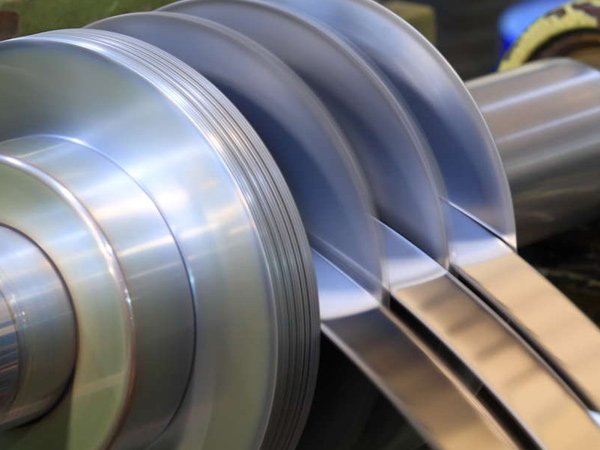
316L, the low carbon version of 316 stainless steel, is immune to grain boundary carbide precipitation (sensitisation). This makes it suited to use in heavy gauge (over about 6mm) welded components. For elevated temperature applications the high carbon variant, 316H stainless steel and the stabilised grade 316Ti stainless steel should be employed.
The austenitic structure of 316 stainless steel gives excellent toughness, even at cryogenic temperatures. Property data given in this document is typical for flat rolled products covered by ASTM A240/A240M. ASTM, EN or other standards may cover products sold. It is reasonable to expect specifications in these standards to be similar but not necessarily identical to those given in this datasheet.
Stainless steel grade 316Ti contains a small amount of titanium. Titanium content is typically only around 0.5%. The titanium atoms stabilise the structure of the 316 at temperatures over 800°C. This prevents carbide precipitation at the grain boundaries and protects the metal from corrosion. The main advantage of 316Ti is that it can be held at higher temperatures for a longer period without sensitisation (precipitation) occurring. 316Ti retains physical and mechanical properties similar to standard grades of 316.
Used in Food Industries, Chemical Industries , Electrielcal Industries, Genrater Industries, Shaft Industries, Cement Industries, Gas Industries, Power Project etc..
| Standard | : | ASTM A240 / ASME SA240 |
| Thickness of Coils | : | Ranging from 0.3mm to 10mm |
| Thickness of Sheets (Cold Rolled) | : | Ranging from 0.3 mm to 6 mm |
| Thickness of Sheets / Plates (Hot Rolled) | : | Ranging from 3.0 mm to 20 mm |
| Width | : | 1000mm / 1219mm /1250mm / 1500mm / 2000mm | Hardness | : | As per ASME A & NACE MR 175 |
| Finish | : | Hot rolled plate (HR), Cold rolled sheet (CR), 2B, 2D, BA NO(8), SATIN (Met with Plastic Coated) |
| Form | : | Coils, Foils, Rolls, Plain Sheet, Shim Sheet, Perforated Sheet, Chequered Plate, Strip, Flats, Blank (Circle), Ring (Flange) etc. |
| Chemical Element | % Present |
|---|---|
| Carbon (C) | 0.0 - 0.08 |
| Chromium (Cr) | 16.00 - 18.00 |
| Molybdenum (Mo) | 2.00 - 3.00 |
| Silicon (Si) | 0.0 - 0.75 |
| Phosphorous (P) | 0.0 - 0.05 |
| Sulphur (S) | 0.0 - 0.03 |
| Nickel (Ni) | 10.00 - 14.00 |
| Titanium (Ti) | 0.0 - 0.70 |
| Iron (Fe) | Balance |
| Density | 8.0 g/cm³ |
| Melting Point | 1400 °C |
| Thermal Expansion | 15.9 x10^-6 /K |
| Modulus of Elasticity | 193 GPa |
| Thermal Conductivity | 16.3 W/m.K |
| Electrical Resistivity | 0.074 x10^-6 Ω .m |